As synchrotron facilities worldwide evolve toward higher brilliance and reduced beam sizes, the mechanical engineering challenges across the entire facility, from accelerator systems to experimental end-stations, become increasingly complex. The MEDSI School 2026 curriculum provides an intensive deep-dive into the latest design methodologies for storage ring components, insertion devices, front-ends, and beamline instrumentation.
The following table outlines our five-day intensive program, followed by specific course descriptions for each technical module.
Below is the outlined five-day intensive program, followed by technical descriptions for each module.
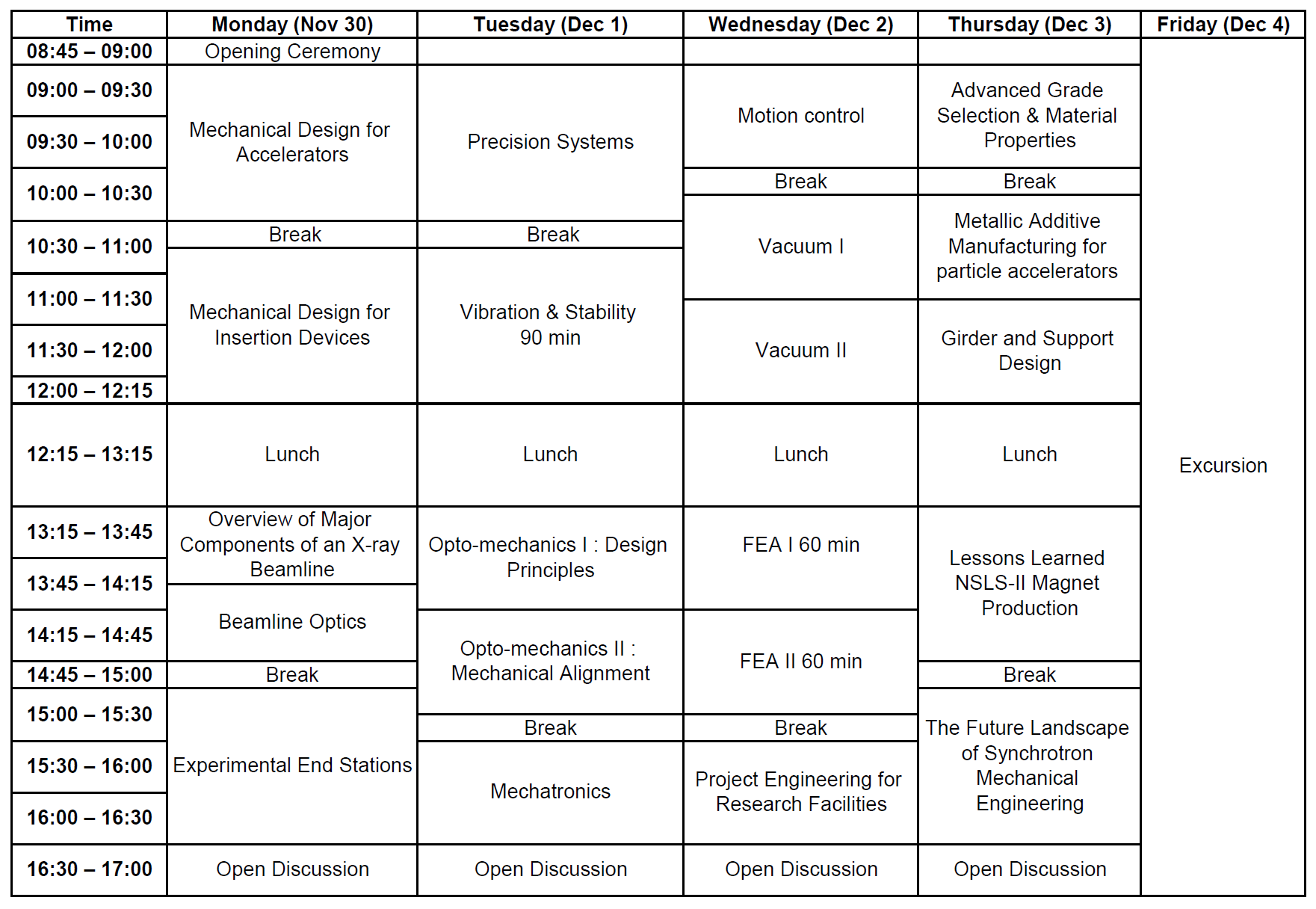
Note: The schedule, lecture topics, and confirmed faculty are tentative at this stage. The Local Scientific & Academic Program Committee maintains the right to update the curriculum to reflect emerging technical standards. Please visit this page regularly for the final program updates.
Course description
1. Overview of Major Components of an X-ray Beamline
An engineering overview of the core components of an X-ray beamline, focusing on how they function and interact as a system. The session delivers an in-depth analysis of optical schemes, including upstream beam conditioning, high-precision mirror technologies for X-ray focusing, and the design of advanced mirror and crystal optics.
2. Mechanical Design for Accelerators
This module will provide a focused overview of mechanical design principles specific to accelerator systems. It will cover key performance requirements, engineering constraints, and the translation of scientific needs into robust mechanical solutions. Emphasis will be placed on design-for-manufacture, material selection, precision engineering, and acceptance criteria to ensure reliability, maintainability, and long-term operational stability.
3. Vacuum Technology
An introduction to the kinetic theory of gases and the design of Ultra-High Vacuum (UHV) systems, including Conflat flanges and Non-Evaporable Getter (NEG) pumps, to enhance beam lifetime and prevent optical contamination. The scope covers molecular flow modeling via Monte Carlo methods, pumping speed selection, and vacuum metrology using gauges and spectrometers.
4. Vibration and Stability
This topic explores strategies for achieving both passive and active stability to mitigate electron and photon beam fluctuations, specifically addressing requirements in the nanometer or nanoradian regime. The curriculum encompasses modal analysis for eigenfrequency identification, Power Spectral Density (PSD) analysis for random loads, and the implementation of active vibration damping systems, alongside optimization methodologies.
5. Beamline Optics
Comprehensive review and optimization of optical schemes, including upstream beam conditioning and mirror technologies for focusing X-ray beams down to nanometric dimensions. This includes the design of mirror and crystal optics to maintain high brilliance and spectral purity. Mechanical manipulation for each optical component.
6. Opto-mechanics I: Design Principles
This session focuses on the precision engineering of mirror mounts, benders, and crystal cooling systems designed to minimize thermal drift and ensure fine angular pointing. The design framework prioritizes the shape preservation of optics at the nanometer level under conditions of intense radiation load.
7. Opto-mechanics II: Mechanical Alignment
This module examines methodologies for the high-precision positioning and alignment of components utilizing autocollimators, interferometers, pulsed wire techniques, and Invar metrology frames. The primary objective is the minimization of Abbe errors in optical assemblies.
8. FEA and Thermal Analysis
This module utilizes numerical modeling to simulate the behavior of continuous media, with a primary focus on structural deformation, stress distribution, and heat transfer. The session addresses specific applications for managing high heat loads in absorbers, monochromators, and optical components via water cooling or cryogenic liquid nitrogen (LN2) circuits.
9. Advanced Grade Selection & Material Properties
A critical evaluation of solid materials—including 316LN stainless steel, aluminum alloys, oxygen-free copper, Glidcop, and CuCrZr—based on key properties such as ductility, thermal conductivity, magnetic permeability, and compatibility with low-temperature and vacuum environments.
10. Metallic Additive Manufacturing for particle accelerators
An overview of the main metal additive manufacturing technologies currently available on the market will be presented. Representative case studies and 3D-printed components produced in different materials will illustrate potential applications in accelerator systems. The benefits of additive manufacturing in terms of design freedom integration of functions and rapid prototyping will be discussed as well as the main challenges.
11. Advanced Fabrication
An overview of high-technology joining techniques, such as Electron-beam (E-beam) welding and vacuum furnace brazing for dissimilar materials. The curriculum covers the integration of additive manufacturing (Laser Powder Bed Fusion - LPBF) for optimized geometries, strict particle-free cleaning protocols, and mechanical design approaches to minimize fabrication errors.
12. Lessons Learned NSLS-II Magnet Production
The procurement of approximately 850 NSLS-II storage ring magnets was successfully completed within a three-year production window (2009–2012). Nearly all units met stringent magnetic field specifications, with only minor, acceptable exceptions. Following initial production delays driven by technical and project management challenges , NSLS-II implemented a multi-pronged mitigation strategy characterized by enhanced technical oversight, rigorous schedule monitoring, and streamlined decision-making. This lecture highlights how the success of large-scale accelerator procurement depends on an active technical partnership with suppliers and intensive monitoring of their performance relative to both technical specifications and delivery schedules.
13. Experimental End Stations
The development and integration of specialized sample environments and detection systems. This includes the engineering of cryostats, automatic sample changers, sample delivery systems, and multi-detector benches.
14. Mechatronics
A multidisciplinary framework integrating precision mechanics, electronic control, and software engineering to optimize system functionality. The session emphasizes systems thinking and the application of software tools, such as Simulink/MATLAB and Python, for dynamic performance validation.
15. Motion Control
An examination of automation sub-fields involving actuators (stepper motors, piezos, hexapods), sensors (encoders, interferometers), and controllers designed for repeatable and accurate positioning. Topics include PID tuning for required bandwidth and stability, as well as motion control architectures, including remote and network control systems.
16. Mechanical Design for Insertion Devices
This session addresses the engineering of insertion devices (IDs) such as the undulators and wigglers, especially focusing on the magnetic, vacuum, and mechanical designs to satisfy the boundary conditions for installation in the storage ring, and requirements on the magnetic quality as synchrotron radiation sources. In addition, details of in-vacuum IDs, where magnetic arrays are located inside the vacuum chamber to enhance the magnetic field, are presented.
17. Project Engineering for Research Facilities
This module will address the fundamentals of project engineering within large-scale research infrastructures. It will highlight structured project planning, technical risk management, system integration, interfaces, and cross-disciplinary coordination. The content is designed to give participants a clear understanding of how to deliver complex engineering projects efficiently while meeting scientific, technical, and safety requirements in a high-stakes research environment.
18. Girder and Support Design
The engineering and micromotion analysis of stiff supporting structures, specifically involving granite supports with high natural frequencies. The objective is the reduction of ground vibrations and environmental noise transmission to heavy girders.
19. Precision Systems
The design of positioning systems with a focus on error budgeting and the identification of positioning deviations. This module addresses resolution requirements ranging from micrometer to nanometer scales for optical components, sample scanners, and high-precision detectors.